
How to Calculate Charge and ΔEₚ from Your CV Curve (in Python)
Calculate Charge from CV — fast, accurate, and in Python

Hello everyone!👋
In today’s issue, we’re diving into a common question in cyclic voltammetry:
How can I calculate anodic/cathodic charge and ΔEₚ from my CV data — all in Python?
Whether you're quantifying redox activity or evaluating reversibility, integrating charge and measuring peak separation are two of the most powerful metrics in electroanalysis.
What Python Does for You
With just a few lines of code in Google Colab, Python can:
🧮 Integrate anodic and cathodic charge using
numpy.trapezoid🎯 Detect oxidation and reduction peaks automatically
🔄 Calculate ΔEₚ (Eₚₐ – Eₚ𝒸) to assess reversibility
🖼️ Label all key values on a beautifully styled CV plot
🧪 Code Preview
# Calculate charge and peak separation
Q_anodic = trapezoid(forward[current], forward[potential])
Q_cathodic = trapezoid(reverse_interp, forward[potential])
delta_Ep = Epa - Epc
# Label everything on the plot
ax.text(..., f"ΔEₚ = {delta_Ep:.3f} V")
ax.text(..., f"Qₐₙₒ = {Q_anodic_uC:.2f} µC")
ax.text(..., f"Eₚₐ = {Epa:.2f} V", ...)
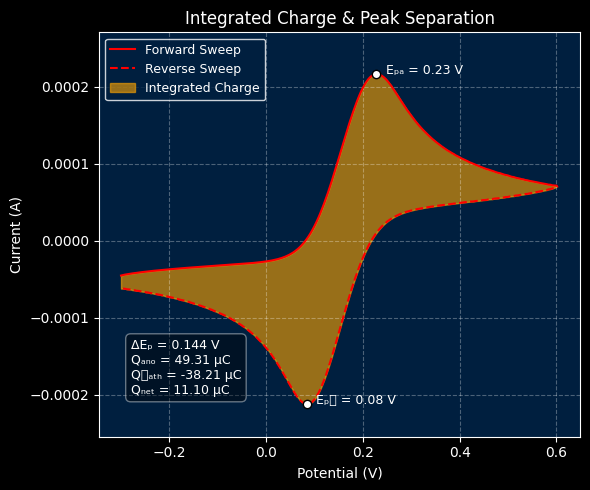
Annotated CV plot with shaded area, peak labels, and integrated charge block
✅ Why This Matters
💡 Compare CV scans across conditions
🔍 Measure electron transfer reversibility
🧯 Spot errors in scan direction or reference shift
🧑🔬 Automate CV analysis — no more manual integration
📽️ Watch the full YouTube tutorial:
👉 YouTube Tutorial: Calculate Charge from CV in Python
📂 Try the Colab notebook here
Download sample data here
❓What else would you want to extract from a CV curve?
Reply and let us know — we’re building templates for:
⏱ Scan rate calculators
📉 Peak current scaling
🔍 Redox reversibility assessment
💬 Try this with your own data
Want to integrate only part of the curve? Or separate oxidation/reduction peaks?
Let us know in the comments — we’ll cover that in future posts.
Happy analysing!
— Python for Electroanalysis Team