
6 Python Libraries Every Battery Scientist Should Know

Whether you’re modelling lithium-ion cells, managing battery test data, or applying machine learning to monitor degradation, Python offers powerful tools tailored for battery scientists.
In this quick-start issue, I’m sharing a visual cheat sheet of six essential Python libraries that power modern battery research:
Infographic:
Python Libraries for Battery Science
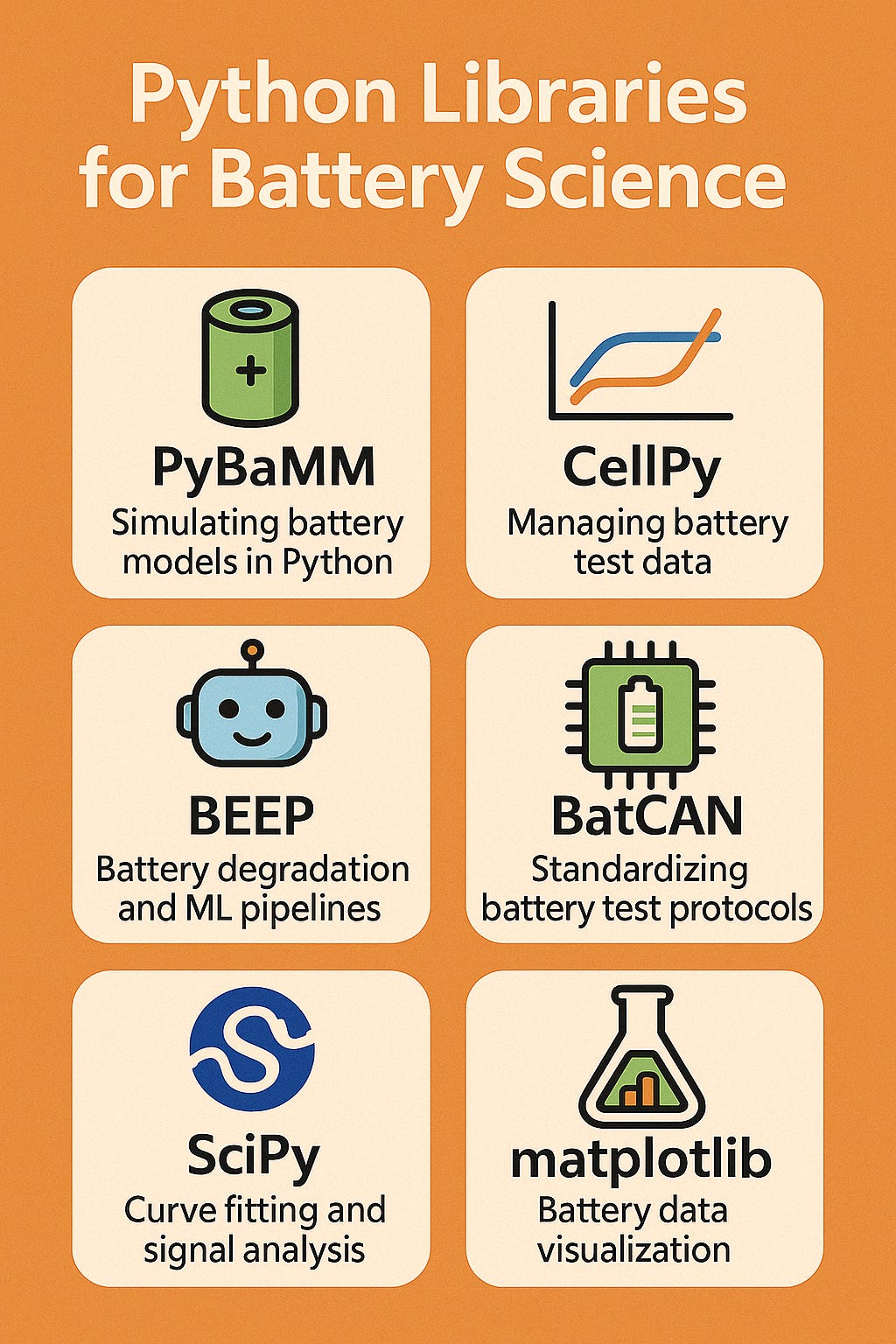
The Essential Battery Python Stack
PyBaMM
Simulating battery models in Python
Great for physics-based modelling, including SEI growth, Li-ion diffusion, and electrochemical behaviour.CellPy
Managing battery test data
Simplifies working with datasets from battery cyclers (like Arbin or Maccor). Clean, structured workflows.BEEP
Battery degradation + ML pipelines
Developed by NREL. Use this to track long-term cycling and build predictive models.BatCAN
Standardising battery test protocols
A communication protocol for organising and syncing test parameters—handy for collaborative labs and automation.SciPy
Curve fitting and signal analysis
Perfect for analysing CV, EIS, and GCD data — extract time constants, fit Tafel slopes, and analyse noise.Matplotlib
Battery data visualisation
Plot voltage curves, dQ/dV graphs, Nyquist plots, and more.
Why This Matters
Battery research is becoming increasingly data-driven. Whether in academia or industry, mastering Python will save you hours and uncover insights buried in your test data.
In future issues, I’ll show you how to use each library with real data and clean, annotated code.
Coming Soon:
Intro to PyBaMM: Building Your First Battery Model
Analysing CV Curves in Python
From Raw Arbin Files to ML Models with BEEP
If you found this helpful, share this issue and subscribe to stay updated.
Until next time, keep coding ⚡
— Auwal (Python for Electroanalysis)